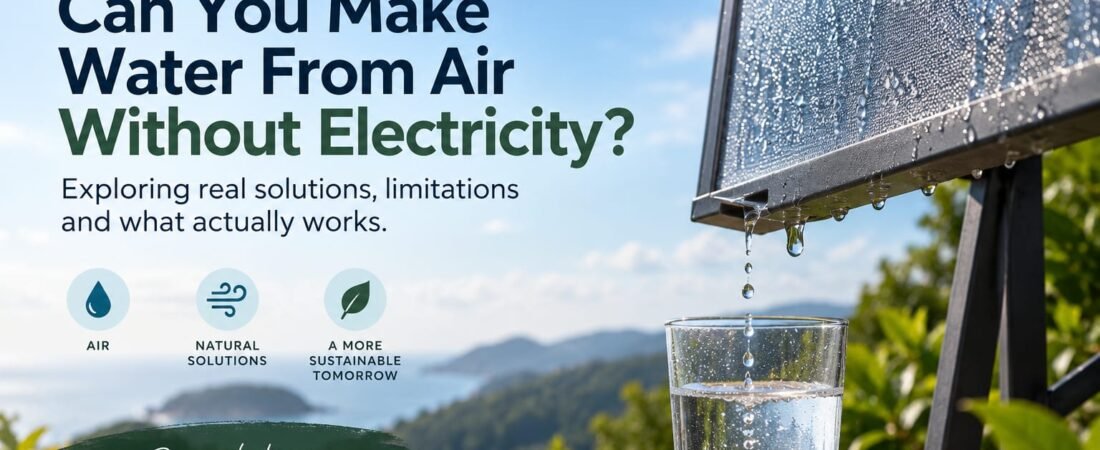
Can you make water from air without electricity? It may sound impossible, but water is all around us — even when we can’t see it.
The air contains water vapor, and technologies known as atmospheric water harvesting systems are designed to capture some of that moisture and turn it into liquid water.
But can you actually make water from air without electricity?
Yes, in some cases — but there’s an important catch. Passive systems can collect atmospheric moisture without conventional electricity, while other methods need energy for cooling, heating, airflow, or condensation. The amount of water you can collect also depends heavily on the climate and the technology being used.
How Is There Water in the Air?
Even on a clear day, the atmosphere contains water vapor.
Even on a clear day, the atmosphere contains water vapor.
The challenge isn’t proving that water is there. It’s finding an efficient way to capture that vapor and turn it into usable liquid water.
Scientists are studying several approaches to atmospheric water harvesting, ranging from fog and dew collection to special materials that absorb water vapor directly from the surrounding air.
Can You Make Water From Air Without Electricity?
There are passive atmospheric water harvesting methods that don’t require conventional electrical power.
Fog collectors, for example, can capture water droplets when environmental conditions are suitable. Other emerging systems use materials called sorbents, which naturally absorb moisture from the air
Some sorbent-based systems can then use solar heat to release the captured moisture so it can be condensed and collected. In other words, they may operate without grid electricity, but they still rely on an energy source — in this case, the sun.
That distinction matters:
“No electricity” does not necessarily mean “no energy.”
What About Atmospheric Water Generators?
This is where things get especially interesting.
Another way to obtain water from air is to cool humid air until the water vapor condenses — somewhat like the droplets that form on the outside of a cold glass.
Unlike passive collection, conventional cooling-based atmospheric water harvesting can require substantial electricity. Researchers are therefore working on technologies that reduce the energy required to extract water from air.
Humidity matters too. Producing water in humid conditions is generally easier than extracting the same amount from very dry air.
So claims that a system can produce a fixed amount of water should always be considered in the context of humidity, temperature, energy consumption and system design.
Can You Generate Water From Air at Home?
Technically, yes.
Atmospheric water generation is not science fiction. The underlying physical processes are well established, and both researchers and commercial developers are working with different approaches to extracting atmospheric moisture.
But building or buying a system does not guarantee unlimited free water.
A household system still has practical considerations:
local humidity, climate, energy requirements, filtration, maintenance, initial cost and expected daily output.
And if the collected water is intended for drinking, water quality and appropriate treatment are essential considerations.
Where Does the Water Freedom System Fit In?
One option aimed specifically at DIY users is the Water Freedom System.
Rather than being a finished atmospheric water generator delivered to your home, Water Freedom is marketed as a digital DIY system that provides instructions for building your own water-producing setup.
The vendor promotes the system as capable of producing up to 60 gallons of water per day. However, that number is a vendor claim, not a production level we independently verified, and real-world atmospheric water output can vary considerably with environmental conditions.
It’s also important not to confuse Water Freedom with the passive technologies discussed earlier. We have not independently verified that the Water Freedom design operates without electricity
That’s why anyone considering it should evaluate the actual design, required components, expected energy use and local climate rather than assuming that “water from air” automatically means “free water without power.”
Interested in the DIY Approach?
If building your own atmospheric water system interests you, you can see exactly what the Water Freedom System includes and decide whether the approach makes sense for your situation.
See the Water Freedom System →
Disclosure: This article contains affiliate links. If you purchase through one of these links, Koriva may earn a commission at no additional cost to you.
The Bottom Line
So, can you make water from air without electricity?
Yes — certain passive methods and solar-driven atmospheric water harvesting technologies can collect moisture without relying on conventional grid electricity. But their effectiveness depends strongly on the environment and the technology involved
Cooling-based atmospheric water generators are different: extracting and condensing moisture this way generally requires energy.
The exciting part isn’t that water can somehow be created from nothing. The water is already in the atmosphere.
The real question is how efficiently — and practically — we can collect it.